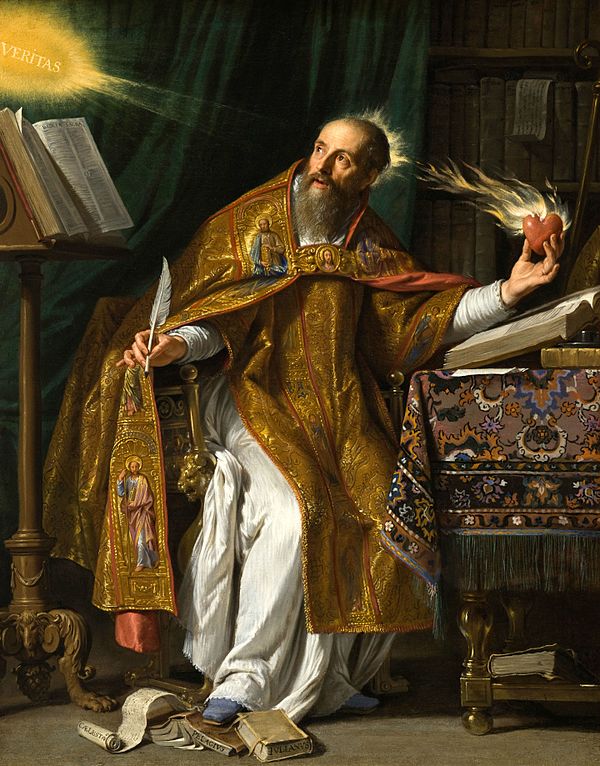
Ambrose baptized Augustine and Alypius at Milan during the Easter Vigil of 387.
Augustine, Confessions 9.6
Augustine attended Ambrose's preaching at Milan and credits him with his conversion.
Augustine, Confessions 5.13-14, 6.3-4
Augustine credits his mother Monica with persistent influence toward his conversion.
Augustine, Confessions 3.11-12, 9.8-13
Lifelong friendship from Thagaste through Carthage, Rome, Milan and back to Africa.
Augustine, Confessions 6.7-10, 8.6, 9.6
taught by (incoming) Possidius of Calama Possidius lived in Augustine's monastic community at Hippo and wrote his Vita.
Possidius, Vita Augustini (preface)
Augustine was deeply moved by hearing of the conversion of Marius Victorinus.
Augustine, Confessions 8.2-5
Extensive (often acrimonious) correspondence over Galatians and the Hebrew text of the OT.
Augustine, Epistulae 28, 40, 71, 82 · Jerome, Epistulae 102, 105, 112, 115
The Pelagian controversy occupied Augustine's last two decades.
Augustine, De Gestis Pelagii · Augustine, De Natura et Gratia
Augustine wrote six books Contra Julianum and the unfinished Opus Imperfectum.
Augustine, Contra Julianum
Augustine wrote against Caelestius alongside Pelagius.
Augustine, De Gratia Christi et de Peccato Originali
corresponded (incoming) Paulinus of Nola Lengthy correspondence preserved on both sides.
Augustine, Epistulae 24-27, 30-32 · Paulinus of Nola, Epistulae 4, 6, 45-50
corresponded (incoming) Prosper of Aquitaine Prosper consulted Augustine on the rise of semi-Pelagianism in southern Gaul.
Augustine, Epistula 225 (Prosper to Augustine)
Prosper systematically defended Augustine's doctrine of grace.
Prosper, Pro Augustino Responsiones; Contra Collatorem
knew of (incoming) Ambrose of Milan Ambrose received Monica's commendation regarding Augustine.
Augustine, Confessions 6.1-2
Gregory draws constantly on Augustine's exegesis and theology in the Moralia and Regula Pastoralis.
Gregory the Great, Moralia in Job, passim · Markus, Gregory the Great and his World, ch. 3
Fulgentius is the most thorough sixth-century Augustinian, citing him constantly in De Fide and the anti-Arian/anti-Pelagian works.
Fulgentius, De Fide ad Petrum · Fulgentius, Contra Fabianum
The Council of Orange (529) under Caesarius drew its canons largely from Augustinian florilegia compiled by Prosper.
Council of Orange (529), Canones · Caesarius, Sermones
Bede draws on Augustine throughout his commentaries; his exegetical method is fundamentally Augustinian.
Bede, In Genesim, In Lucam, etc. · Bede, Retractatio in Acta Apostolorum, prologue
cited (incoming) Boethius Boethius cites Augustine as authority in De Trinitate and follows Augustinian Trinitarian formulations.
Boethius, De Trinitate, prologue
cited (incoming) Cassiodorus Cassiodorus' Expositio Psalmorum is built on Augustine's Enarrationes in Psalmos.
Cassiodorus, Expositio Psalmorum, praefatio
cited (incoming) Gregory of Tours Gregory cites Augustine's De civitate Dei and Augustine's exegesis at several points in his Histories and miracle books.
Gregory of Tours, Hist. Franc. 1 prologue · Heinzelmann, Gregory of Tours: History and Society in the Sixth Century (CUP 2001), pp. 110-114
Augustine preached three surviving sermons (280-282) on the feast of Perpetua and Felicity at Carthage and Hippo.
Augustine, Sermons 280, 281, 282
Augustine's sermons 280-282 commemorate Felicity jointly with Perpetua.
Augustine, Sermons 280, 281, 282
Gerontius's Vita records Melania and Pinianus residing near Hippo c. 410-417 and meeting Augustine and Alypius; Augustine's Letter 124 is addressed to them.
Gerontius, Vita Melaniae Iunioris 20-21 · Augustine, Epistula 124