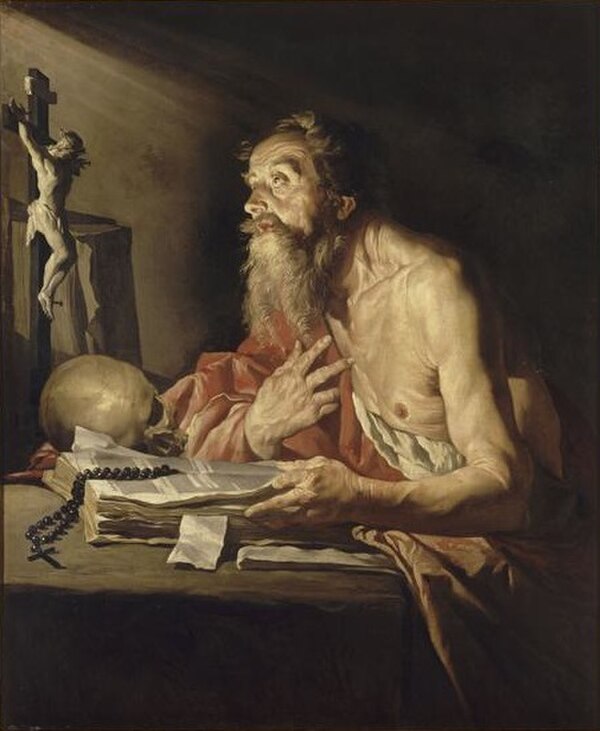
Portrait of Jerome
via Wikipedia

Jerome

c. 347 – 420 · b. Stridon
PresbyterTheologianMonk

Quick facts

Born
c. 347, Stridon
Died
420, Bethlehem
Region
palestine
Era
nicene
Significance
Major Father(3/4)
Also known as
Eusebius Sophronius Hieronymus · Hieronymus

Highlights

Main contribution
Jerome gave the Latin West its Bible.
Best first read
Letters
Primary source
Jerome, Epistulae

Translator of the Latin Vulgate Bible; biblical scholar and prolific letter-writer. Settled in Bethlehem from 386.

Why Jerome matters

Jerome gave the Latin West its Bible. He learned Hebrew when most Christian scholars still depended on Greek, settled in Bethlehem, and translated scripture from the original languages into the Latin text later known as the Vulgate. For a thousand years, when Western Christians heard, copied, preached, and argued over scripture, Jerome's Latin was usually the text in front of them. His temperament was sharp and often unpleasant, but his scholarly achievement changed the daily life of the church.

Recommended reading near Jerome

A cover-visible starting point chosen from the curated reading path, either by this figure or by their era.

More books →
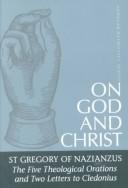
Cover of On God and Christ by Gregory of Nazianzus
Read this when you want the high-theology version of Nicaea.

Five Theological Orations

Gregory of Nazianzus

Dense but decisive sermons on the Trinity from the theologian of Constantinople.
Chain to Jesus

Loading…

Common questions

Who was Jerome?
Jerome (347–420) — Translator of the Latin Vulgate Bible; biblical scholar and prolific letter-writer. Settled in Bethlehem from 386.
Who taught Jerome?
Didymus the Blind.
Who did Jerome correspond with?
Augustine of Hippo, Rufinus of Aquileia, Pope Damasus I, Paulinus of Nola, Chromatius of Aquileia, Paula of Rome, and Eustochium.
Who did Jerome meet?
Epiphanius of Salamis.
Who did Jerome oppose?
Rufinus of Aquileia and Pelagius.

Works

  • Lettersc. 405

    Voluminous correspondence covering scripture, monasticism, controversy, and spiritual direction.

  • On Illustrious Men (De Viris Illustribus)c. 393

    Brief biographies of Christian writers — the first Christian literary history.

  • Vulgate (Latin Bible translation)c. 405

    His translation from Hebrew + Greek originals; the standard Western Bible for 1,000 years.

  • Commentary on Danielc. 407

    Defended Daniel's authenticity against Porphyry; standard Western reading for centuries.

  • Apology Against Rufinusc. 402

    Polemic on Origen's orthodoxy; the breakdown of a major scholarly friendship.

As an Amazon Associate we earn from qualifying purchases.

Sources for biography

  • Jerome, Epistulae primary
  • Jerome, De Viris Illustribus 135 primary
  • Augustine, Epistulae 28, 71, 75 primary

documented connections(12)

  • corresponded (incoming) Augustine of Hippo
    Extensive (often acrimonious) correspondence over Galatians and the Hebrew text of the OT.
    Augustine, Epistulae 28, 40, 71, 82 · Jerome, Epistulae 102, 105, 112, 115
  • corresponded Rufinus of Aquileia
    Friends from youth in Aquileia who became bitter opponents over Origenism.
    Jerome, Apologia contra Rufinum · Rufinus, Apologia contra Hieronymum
  • The Origenist controversy split the two former friends c. 393-402.
    Jerome, Epistula 84 · Jerome, Apologia contra Rufinum 1-3
  • corresponded Pope Damasus I
    Damasus commissioned Jerome's revision of the Latin Bible.
    Jerome, Epistulae 15, 18, 35-36 · Jerome, Praefatio in Evangelia (ad Damasum)
  • Jerome and Epiphanius were close allies in the Origenist controversy.
    Jerome, Epistulae 51, 57, 82
  • opposed Pelagius
    Jerome wrote a Dialogus contra Pelagianos.
    Jerome, Dialogus contra Pelagianos
  • corresponded (incoming) Paulinus of Nola
    Paulinus exchanged letters with Jerome on biblical study.
    Jerome, Epistulae 53, 58, 85
  • Jerome studied with Didymus at Alexandria c. 386.
    Jerome, De Viris Illustribus 109, 135
  • corresponded (incoming) Chromatius of Aquileia
    Chromatius supported Jerome's biblical work financially and by patronage.
    Jerome, Epistulae 7, 8
  • cited (incoming) Bede the Venerable
    Bede uses Jerome's commentaries and the Vulgate extensively.
    Bede, In Marcum, prologue
  • corresponded (incoming) Paula of Rome
    Paula and Eustochium are joint addressees of numerous Hieronymian letters and prefaces; Jerome composed her epitaph.
    Jerome, Epistulae 30, 39, 46, 108
  • corresponded (incoming) Eustochium
    Recipient of Jerome's Letter 22 (Ad Eustochium) and dedicatee of multiple biblical commentaries.
    Jerome, Epistula 22 · Jerome, prefaces to commentaries on Isaiah, Ezekiel and the Minor Prophets

External resources

·XFacebookRedditEmail