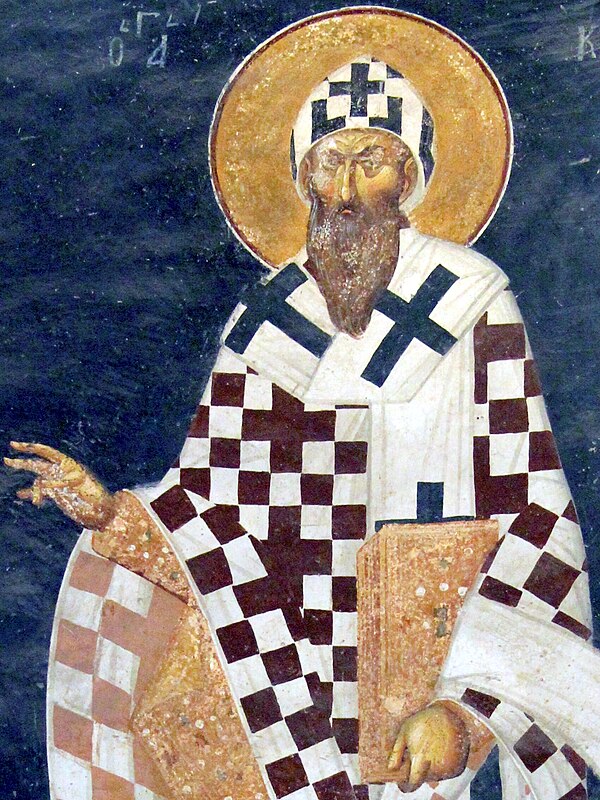
Cyril of Alexandria
Patriarch of Alexandria. Chief architect of Christological orthodoxy; presided over the Council of Ephesus (431) which condemned Nestorius.
Why Cyril matters
Cyril is the most brilliant and the most ruthless. His Christology — one person, two natures, a real unity in Christ — won at the Council of Ephesus in 431 and shaped Chalcedon twenty years later. Every later orthodox account of who Jesus is starts from Cyril. He's also the bishop in whose Alexandria the philosopher Hypatia was murdered by a Christian mob in 415, and he ran Nestorius into the ground with political tactics that were ugly even by fifth-century standards. The church canonised him anyway because his theology held. Read his On the Unity of Christ — it's the cleanest statement of how Christ can be one without being a blend.
Chain to Jesus
Loading…
Common questions
- Who was Cyril of Alexandria?
- Cyril of Alexandria (376–444) — Patriarch of Alexandria. Chief architect of Christological orthodoxy; presided over the Council of Ephesus (431) which condemned Nestorius.
- Who did Cyril of Alexandria correspond with?
- Pope Celestine I and Augustine of Hippo.
- Who did Cyril of Alexandria meet?
- Shenoute of Atripe and Melania the Younger.
- Who did Cyril of Alexandria oppose?
- Nestorius and Theodoret of Cyrus.
- Who did Cyril of Alexandria succeed as bishop of Alexandria?
- Athanasius of Alexandria.
- Who succeeded Cyril of Alexandria as bishop of Alexandria?
- Dioscorus of Alexandria.
Works
- On the Unity of Christc. 438
Cyril's mature Christology defending the single subject of the incarnate Word.
As an Amazon Associate we earn from qualifying purchases.
Sources for biography
- Cyril, Epistulae (esp. 4, 17, 39) primary
- Acta Concilii Ephesini (431) primary
- Socrates Scholasticus, Hist. Eccl. 7 primary
documented connections(6)
- opposed NestoriusCyril led the condemnation of Nestorius at the Council of Ephesus (431).Cyril, Epistulae 4, 17 · Acta Concilii Ephesini (431)
- opposed (incoming) Theodoret of CyrusTheodoret wrote a refutation of Cyril's Twelve Anathemas.Theodoret, Reprehensio XII Capitum Cyrilli
- corresponded (incoming) Pope Celestine ICelestine commissioned Cyril to act on his behalf against Nestorius.Acta Concilii Ephesini (431); letters of Celestine to Cyril
- succeeded in see (incoming) Dioscorus of AlexandriaDioscorus succeeded Cyril as patriarch of Alexandria in 444.Liberatus, Breviarium 12
- cited Athanasius of AlexandriaCyril repeatedly invokes Athanasius as the standard of orthodoxy.Cyril, Epistulae 1, 39
- cited (incoming) Severus of AntiochSeverus appealed to Cyril's mia physis formula as the basis of his Christology.Severus, Liber contra impium Grammaticum
tradition connections(4)
- succeeded in see Athanasius of AlexandriaCyril became Patriarch of Alexandria (412) several bishops after Athanasius (d. 373) — Peter II, Timothy, Theophilus all intervened. Not a direct succession.Socrates Scholasticus, Hist. Eccl. 7.7
- corresponded (incoming) Augustine of HippoCyril sent Augustine documents on the Nestorian controversy shortly before Augustine's death.Augustine, Epistula 4* (Divjak)
- met (incoming) Shenoute of AtripeBesa's Vita Sinuthii reports Shenoute accompanying Cyril to the Council of Ephesus in 431; this is attested in the hagiographic tradition rather than in conciliar acta.Besa, Vita Sinuthii · ODCC s.v. Shenoute
- met (incoming) Melania the YoungerVita Melaniae reports a visit to Alexandria where she received Cyril; primary attestation rests on the Vita alone.Gerontius, Vita Melaniae Iunioris 34