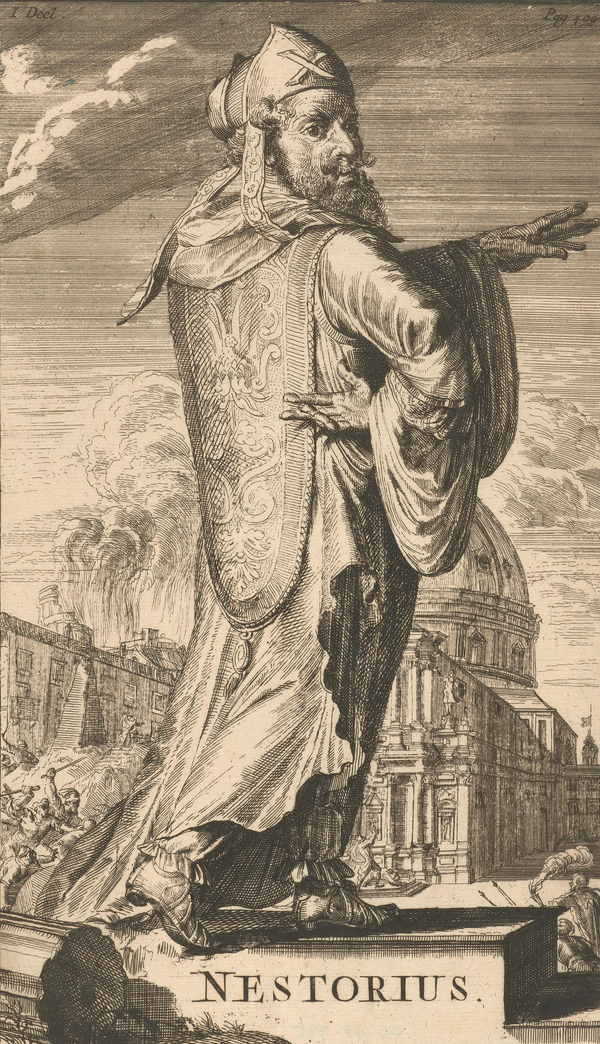
Nestorius
Archbishop of Constantinople (428-431). Condemned at Ephesus (431) for distinguishing two persons in Christ and denying the title Theotokos. Heretic.
Why Nestorius matters
Nestorius is on this site because he lost the argument that named a heresy. Patriarch of Constantinople from 428, he objected to calling Mary 'Theotokos' (God-bearer), preferring 'Christotokos' (Christ-bearer), because he wanted to keep the human and divine natures of Christ from blurring into each other. Cyril of Alexandria attacked him hard, the Council of Ephesus in 431 deposed him, and he died in exile. Whether he actually taught what 'Nestorianism' came to mean is debated — his own Bazaar of Heracleides, found in 1895, suggests he was closer to Chalcedonian orthodoxy than his enemies allowed. The Church of the East, still living today across Iraq, Iran, and India, is his lineage.
Chain to Jesus
Loading…
Common questions
- Who was Nestorius?
- Nestorius (386–451) — Archbishop of Constantinople (428-431). Condemned at Ephesus (431) for distinguishing two persons in Christ and denying the title Theotokos. Heretic.
- Who taught Nestorius?
- Theodore of Mopsuestia.
- Who did Nestorius oppose?
- Cyril of Alexandria.
- Who did Nestorius succeed as bishop of Constantinople?
- John Chrysostom.
- Who succeeded Nestorius as bishop of Constantinople?
- Flavian of Constantinople.
Sources for biography
- Nestorius, Liber Heraclidis (Bazaar of Heracleides) primary
- Socrates Scholasticus, Hist. Eccl. 7.29-7.34 primary
- Acta Concilii Ephesini (431) primary
documented connections(1)
- opposed (incoming) Cyril of AlexandriaCyril led the condemnation of Nestorius at the Council of Ephesus (431).Cyril, Epistulae 4, 17 · Acta Concilii Ephesini (431)
tradition connections(3)
- taught by Theodore of MopsuestiaNestorius is traditionally counted as a pupil of Theodore at Antioch.Socrates Scholasticus, Hist. Eccl. 7.29
- succeeded in see John ChrysostomNestorius became Archbishop of Constantinople (428) some years after Chrysostom (d. 407), via intervening bishops Arsacius, Atticus, and Sisinnius — not a direct succession.Socrates Scholasticus, Hist. Eccl. 7.29
- succeeded in see (incoming) Flavian of ConstantinopleFlavian became Archbishop of Constantinople (446) several bishops after Nestorius (Maximian, Proclus); not a direct succession.Socrates Scholasticus, Hist. Eccl. 7.40-48