← Lineage
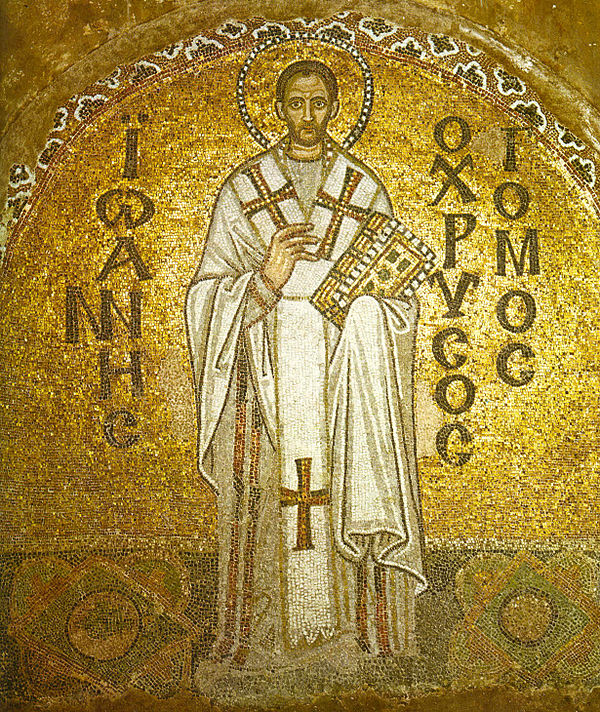
Portrait of John Chrysostom
via Wikipedia

John Chrysostom

c. 349 – 407 · b. Antioch · Bishop of Constantinople
bishoptheologian

Archbishop of Constantinople, called 'Golden-Mouth' for his preaching. Greatest preacher of the Greek Fathers; deposed and exiled at the Synod of the Oak (403).

Why John Chrysostom matters

Chrysostom means 'golden-mouth.' He was the greatest preacher in the early church and one of the few who used that gift to attack power directly — luxury, the rich oppressing the poor, the imperial court — until they exiled him for it. He died on a forced march. His sermons on Matthew and his homilies on wealth and poverty are still the place to start if you want patristic preaching that lands like it was written this morning. Eastern Orthodoxy still uses his liturgy every Sunday.

Chain to Jesus

Loading…

Common questions

Who was John Chrysostom?
John Chrysostom (349–407) — Archbishop of Constantinople, called 'Golden-Mouth' for his preaching. Greatest preacher of the Greek Fathers; deposed and exiled at the Synod of the Oak (403).
Who taught John Chrysostom?
Diodore of Tarsus.
Who did John Chrysostom teach?
John Cassian.
Who did John Chrysostom correspond with?
Pope Innocent I and Olympias the Deaconess.
Who did John Chrysostom oppose?
Epiphanius of Salamis.
Who succeeded John Chrysostom as bishop of Constantinople?
Nestorius.

Works

  • Homilies on the Gospel of Matthewc. 390

    Ninety homilies that became the standard patristic commentary on Matthew.

  • On Wealth and Povertyc. 388

    Seven sermons on Lazarus and the rich man — sharp social and economic preaching.

As an Amazon Associate we earn from qualifying purchases.

Sources for biography

  • Palladius, Dialogus de Vita Joannis Chrysostomi primary
  • Socrates Scholasticus, Hist. Eccl. 6 primary
  • Sozomen, Hist. Eccl. 8 primary

documented connections(6)

  • taught by (incoming) John Cassian
    Cassian was ordained deacon by Chrysostom and travelled to Rome to plead his cause.
    Cassian, De Incarnatione 7.31 · Palladius, Dialogus 3
  • Chrysostom was a pupil of Diodore at Antioch.
    Socrates Scholasticus, Hist. Eccl. 6.3 · Sozomen, Hist. Eccl. 8.2
  • Chrysostom and Epiphanius clashed over Origenism at Constantinople in 403.
    Socrates Scholasticus, Hist. Eccl. 6.10-14 · Sozomen, Hist. Eccl. 8.14-15
  • knew of (incoming) Palladius of Galatia
    Palladius wrote the Dialogus on Chrysostom's life.
    Palladius, Dialogus de Vita Joannis Chrysostomi
  • corresponded Pope Innocent I
    Chrysostom appealed to Innocent after his deposition.
    Palladius, Dialogus 2
  • corresponded (incoming) Olympias the Deaconess
    Seventeen letters from Chrysostom to Olympias survive, written largely from his exile.
    John Chrysostom, Epistulae ad Olympiadem · Palladius, Dialogus de Vita Iohannis Chrysostomi 16-17

tradition connections(2)

  • succeeded in see (incoming) Nestorius
    Nestorius became Archbishop of Constantinople (428) some years after Chrysostom (d. 407), via intervening bishops Arsacius, Atticus, and Sisinnius — not a direct succession.
    Socrates Scholasticus, Hist. Eccl. 7.29
  • cited (incoming) Mesrop Mashtots
    The 5th-century Armenian translation school founded by Mesrop and Sahak rendered Chrysostom's homilies into Armenian; Koriun describes the translation programme.
    Koriun, Life of Mashtots 11-19 · Thomson, A Bibliography of Classical Armenian Literature to 1500 AD (Brepols 1995), s.v. John Chrysostom

Read more