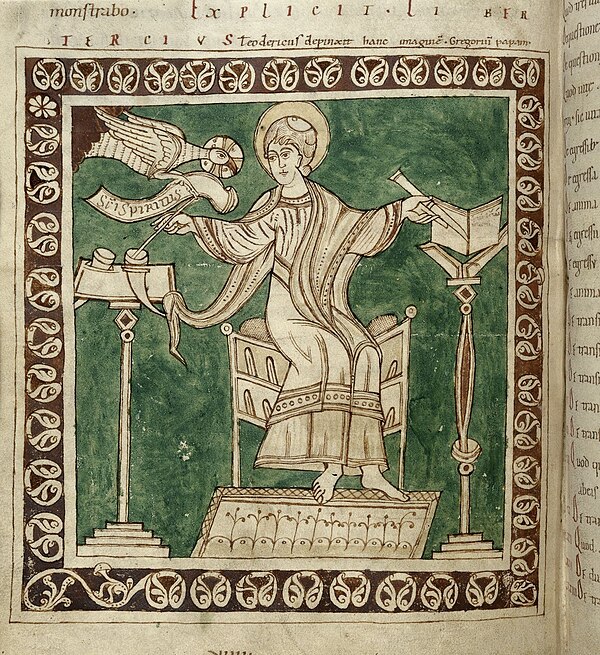
Pope Gregory I (the Great)
Pope from 590-604 and one of the four traditional Latin Doctors of the Church. Wrote the Moralia in Job, Pastoral Rule, Dialogues, and ~850 letters. Sent the Gregorian mission under Augustine to convert the Anglo-Saxons. Reformed liturgy and chant; deeply indebted to Augustine.
Why Pope Gregory I (the Great) matters
Gregory was a Roman aristocrat who became a monk, then was drafted to be Pope, and during fourteen years in office (590–604) reorganised the Western church for the medieval world. He sent Augustine of Canterbury to convert the Anglo-Saxons, codified the chant that bears his name, wrote the Pastoral Care that every medieval bishop used as a manual, and held Italy together as the Roman state collapsed around him. The reason 'medieval' Christianity has the shape it does is largely his.
Chain to Jesus
Loading…
Common questions
- Who was Pope Gregory I (the Great)?
- Pope Gregory I (the Great) (540–604) — Pope from 590-604 and one of the four traditional Latin Doctors of the Church. Wrote the Moralia in Job, Pastoral Rule, Dialogues, and ~850 letters. Sent the Gregorian mission under Augustine to convert the Anglo-Saxons. Reformed liturgy and chant; deeply indebted to Augustine.
- Who did Pope Gregory I (the Great) teach?
- Augustine of Canterbury.
- Who did Pope Gregory I (the Great) correspond with?
- Augustine of Canterbury, Leander of Seville, and Columbanus.
- Who did Pope Gregory I (the Great) meet?
- Leander of Seville.
- Who did Pope Gregory I (the Great) oppose?
- Eutychius of Constantinople.
Works
- Pastoral Care (Liber Regulae Pastoralis)c. 591
Manual for bishops — the standard handbook for medieval prelates.
- Dialoguesc. 593
Four books of saints' lives, including the principal life of Benedict.
- Moralia in Jobc. 595
Massive thirty-five-book moral and allegorical commentary on Job.
As an Amazon Associate we earn from qualifying purchases.
Sources for biography
- Gregory the Great, Moralia in Job primary
- Gregory the Great, Regula Pastoralis primary
- Gregory the Great, Registrum Epistolarum primary
- Bede, Hist. Eccl. 2.1 primary
documented connections(10)
- taught by (incoming) Augustine of CanterburyGregory commissioned Augustine to lead the mission to the Anglo-Saxons in 596 and exchanged letters with him giving instruction.Bede, Hist. Eccl. 1.23-1.32 · Gregory the Great, Registrum Epistolarum 6.51, 11.36
- corresponded Augustine of CanterburySurviving letters of Gregory to Augustine on missionary practice and church organization (the 'Libellus Responsionum').Gregory the Great, Registrum 11.56a · Bede, Hist. Eccl. 1.27
- cited Augustine of HippoGregory draws constantly on Augustine's exegesis and theology in the Moralia and Regula Pastoralis.Gregory the Great, Moralia in Job, passim · Markus, Gregory the Great and his World, ch. 3
- Gregory met Leander in Constantinople when both were on diplomatic/ecclesial business; the Moralia in Job is dedicated to Leander.Gregory the Great, Moralia in Job, Epistula ad Leandrum · Gregory the Great, Registrum 1.41, 5.53
- corresponded Leander of SevilleLetters survive between the two.Gregory the Great, Registrum 1.41, 5.53, 9.121
- knew of Benedict of NursiaGregory wrote the principal biography of Benedict in Dialogues Book 2 within ~50 years of Benedict's death, drawing on disciples' testimony.Gregory the Great, Dialogues 2, prologue
- cited (incoming) Bede the VenerableBede cites Gregory's Moralia, Pastoral Rule, and Homilies pervasively, and gives him the most affectionate treatment in the Historia Ecclesiastica.Bede, Hist. Eccl. 2.1 · Bede, In Cantica Canticorum
- opposed (incoming) Eutychius of ConstantinopleWhile Gregory was apocrisarius in Constantinople he disputed publicly with Eutychius over the corporeality of the resurrection body.Gregory the Great, Moralia in Job 14.72-74
- corresponded (incoming) ColumbanusColumbanus wrote to Pope Gregory I on the date of Easter (Epistola 1).Columbanus, Epistola 1
- cited (incoming) BonifaceBoniface modelled his missionary methods on Gregory's instructions to Augustine of Canterbury and corresponded with Gregory's papal successors.Boniface, Epistolae · Willibald, Vita Bonifatii