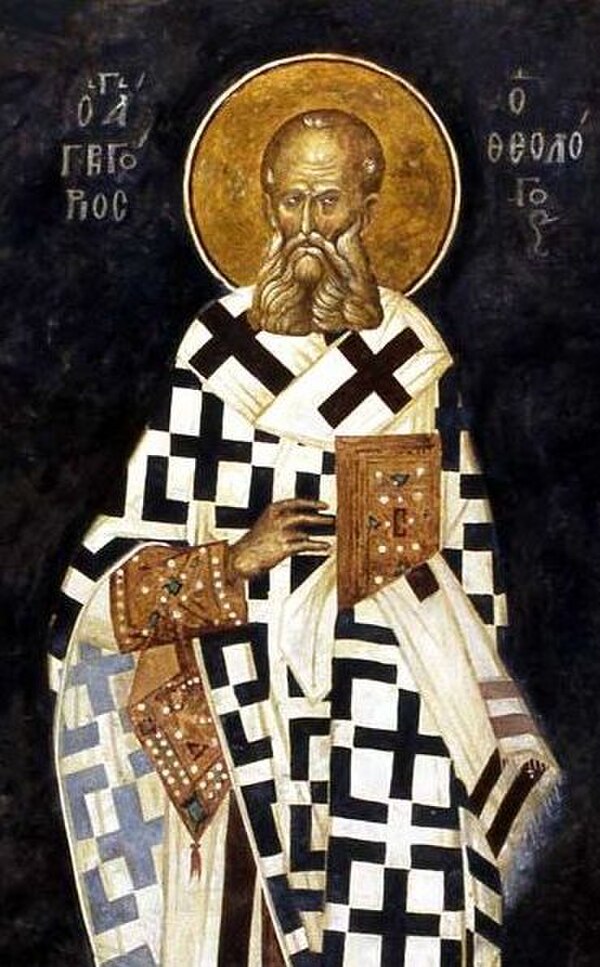
Portrait of Gregory of Nazianzus
via Wikipedia

Gregory of Nazianzus

c. 329 – 390 · b. Arianzus · Bishop of Constantinople
BishopTheologian

Quick facts

Born
c. 329, Arianzus
Died
390, Arianzus
See
Constantinople
Region
asia minor
Era
nicene
Significance
Major Father(3/4)
Also known as
Gregory the Theologian

Highlights

Main contribution
Gregory of Nazianzus gave the church some of its clearest language for the Trinity.
Primary source
Gregory of Nazianzus, Orationes 27-31 (Theological Orations)

Cappadocian Father, briefly Archbishop of Constantinople (380-381) and presider over the First Council of Constantinople. Known as 'the Theologian' for his Five Theological Orations.

Why Gregory matters

Gregory of Nazianzus gave the church some of its clearest language for the Trinity. In Constantinople in 380, with Nicene Christians still under pressure, he preached the Five Theological Orations that explained how Father, Son, and Spirit are distinct without dividing God. He did not want an imperial career and repeatedly tried to withdraw from public office, but the crisis demanded someone who could speak precisely. After Gregory, loose Trinitarian language became much harder to defend.

Recommended reading near Gregory

A cover-visible starting point chosen from the curated reading path, either by this figure or by their era.

More books →
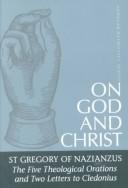
Cover of On God and Christ by Gregory of Nazianzus
Read this when you want the high-theology version of Nicaea.

Five Theological Orations

Gregory of Nazianzus

Dense but decisive sermons on the Trinity from the theologian of Constantinople.
Chain to Jesus

Loading…

Common questions

Who was Gregory of Nazianzus?
Gregory of Nazianzus (329–390) — Cappadocian Father, briefly Archbishop of Constantinople (380-381) and presider over the First Council of Constantinople. Known as 'the Theologian' for his Five Theological Orations.
Who taught Gregory of Nazianzus?
Gregory the Elder of Nazianzus.
Who did Gregory of Nazianzus teach?
Evagrius Ponticus.
Who did Gregory of Nazianzus correspond with?
Basil of Caesarea.
Who did Gregory of Nazianzus meet?
Basil of Caesarea and Cyril of Jerusalem.
Who did Gregory of Nazianzus oppose?
Apollinaris of Laodicea.

Works

  • Five Theological Orationsc. 380

    Constantinople sermons that earned him the title 'the Theologian' — defining Trinitarian orthodoxy.

  • Orationsc. 380

    45 surviving sermons; sets the standard for patristic homiletics.

  • Autobiographical Poem (De Vita Sua)c. 382

    Verse autobiography in 1949 lines; rare patristic genre.

  • Lettersc. 380

    249 letters preserved; conventional epistolary collection in classical style.

As an Amazon Associate we earn from qualifying purchases.

Sources for biography

  • Gregory of Nazianzus, Orationes 27-31 (Theological Orations) primary
  • Gregory of Nazianzus, De Vita Sua primary
  • Jerome, De Viris Illustribus 117 primary

documented connections(9)

  • met (incoming) Basil of Caesarea
    Basil and Gregory were close friends from their student days at Athens.
    Gregory of Nazianzus, Oratio 43.14-24
  • corresponded Basil of Caesarea
    Surviving correspondence and the joint Philocalia of Origen.
    Gregory of Nazianzus, Epistulae 1-19, 40-58 · Basil, Epistulae 2, 14, 71
  • Co-compiler with Basil of the Philocalia of Origen.
    Gregory of Nazianzus, Epistula 115
  • knew of (incoming) Amphilochius of Iconium
    Amphilochius was a cousin of Gregory of Nazianzus.
    Gregory of Nazianzus, Epistulae 9, 13, 25-26
  • Gregory the Theologian was raised and ordained presbyter by his father.
    Gregory of Nazianzus, Oratio 18 · Gregory of Nazianzus, De Vita Sua
  • taught by (incoming) Evagrius Ponticus
    Gregory ordained Evagrius deacon and trained him at Constantinople.
    Palladius, Historia Lausiaca 38 · Socrates Scholasticus, Hist. Eccl. 4.23
  • met (incoming) Cyril of Jerusalem
    Both attended the First Council of Constantinople in 381; Cyril is listed among the 150 fathers and Gregory presided briefly over the council.
    Acta of the First Council of Constantinople (381) · Theodoret, Hist. Eccl. 5.8-9
  • cited (incoming) John of Damascus
    John drew especially on Gregory of Nazianzus' Theological Orations.
    John of Damascus, De Fide Orthodoxa, passim
  • Gregory's two letters to Cledonius (Ep. 101, 102) are the classic Cappadocian refutation of Apollinarian Christology, with the famous formula 'what has not been assumed has not been healed.'
    Gregory of Nazianzus, Epistulae 101, 102

External resources

·XFacebookRedditEmail