← Lineage
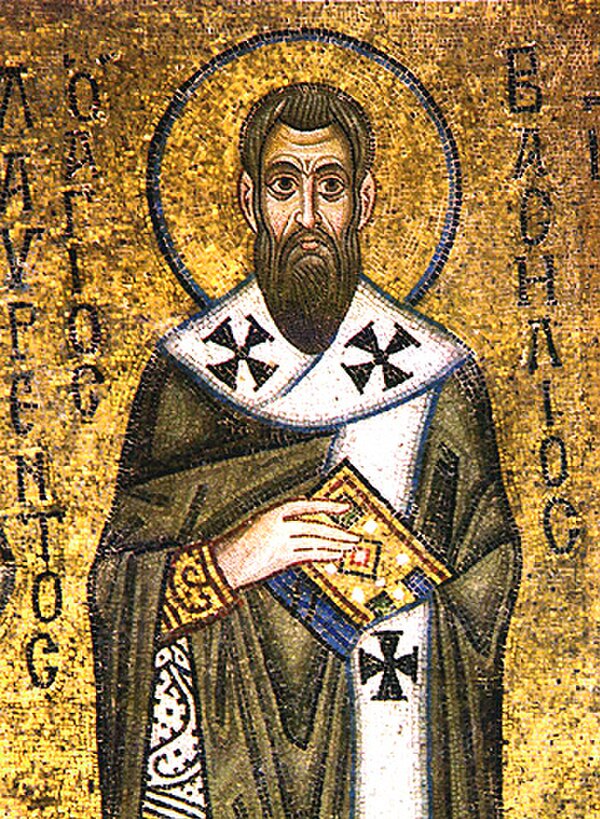
Portrait of Basil of Caesarea
via Wikipedia

Basil of Caesarea

330 – 379 · b. Caesarea Mazaca · Bishop of Caesarea Mazaca
bishoptheologianmonk

Bishop of Caesarea in Cappadocia, founder of cenobitic monastic rules in the East, author of On the Holy Spirit. One of the three Cappadocian Fathers.

Why Basil matters

Basil organised the Christian East. He wrote the rule that every Eastern monastery still uses, founded a complex of hospitals and shelters that became the prototype for Christian welfare, and at the same time fought the Arian controversy down to its details. He's the reason Eastern monasticism stayed inside the city rather than fleeing to the desert — a more sustainable model than Antony's. He died young (49). His brother Gregory of Nyssa and his friend Gregory of Nazianzus carried the work to Constantinople 381 and Trinitarian orthodoxy as we have it.

Chain to Jesus

Loading…

Common questions

Who was Basil of Caesarea?
Basil of Caesarea (330–379) — Bishop of Caesarea in Cappadocia, founder of cenobitic monastic rules in the East, author of On the Holy Spirit. One of the three Cappadocian Fathers.
Who taught Basil of Caesarea?
Macrina the Younger.
Who did Basil of Caesarea teach?
Gregory of Nyssa and Evagrius Ponticus.
Who did Basil of Caesarea correspond with?
Gregory of Nazianzus, Amphilochius of Iconium, Ambrose of Milan, and Athanasius of Alexandria.
Who did Basil of Caesarea meet?
Gregory of Nazianzus and Ephrem the Syrian.

Works

  • On the Holy Spiritc. 375

    Foundational defense of the Spirit's divinity in the lead-up to Constantinople 381.

  • Hexaemeron (Homilies on the Six Days of Creation)c. 378

    Nine homilies on Genesis — a model for medieval natural theology.

As an Amazon Associate we earn from qualifying purchases.

Sources for biography

  • Basil, Epistulae primary
  • Gregory of Nazianzus, Oratio 43 (Funeral oration on Basil) primary
  • Jerome, De Viris Illustribus 116 primary

documented connections(11)

  • Macrina spiritually shaped her younger brother Basil after his return from Athens.
    Gregory of Nyssa, Vita Macrinae 6
  • taught by (incoming) Gregory of Nyssa
    Gregory describes Basil as his teacher and elder brother.
    Gregory of Nyssa, Contra Eunomium 1.1
  • Basil and Gregory were close friends from their student days at Athens.
    Gregory of Nazianzus, Oratio 43.14-24
  • corresponded (incoming) Gregory of Nazianzus
    Surviving correspondence and the joint Philocalia of Origen.
    Gregory of Nazianzus, Epistulae 1-19, 40-58 · Basil, Epistulae 2, 14, 71
  • Basil and Gregory of Nazianzus compiled the Philocalia, an anthology of Origen.
    Gregory of Nazianzus, Epistula 115
  • corresponded (incoming) Amphilochius of Iconium
    Basil's De Spiritu Sancto is dedicated to Amphilochius.
    Basil, De Spiritu Sancto (preface) · Basil, Epistulae 161, 188, 199
  • corresponded (incoming) Ambrose of Milan
    Ambrose's De Spiritu Sancto draws heavily on Basil; correspondence between Eastern and Western Nicenes.
    Ambrose, De Spiritu Sancto (passim) · Basil, Epistulae 197
  • cited (incoming) Ambrose of Milan
    Ambrose's De Spiritu Sancto adapts Basil's work of the same title.
    Ambrose, De Spiritu Sancto
  • Basil wrote to Athanasius seeking unity with Rome.
    Basil, Epistulae 66, 69, 80, 82
  • taught by (incoming) Evagrius Ponticus
    Basil ordained Evagrius lector at Caesarea.
    Palladius, Historia Lausiaca 38
  • cited (incoming) John of Damascus
    John cites the Cappadocians (Basil, Gregory of Nazianzus, Gregory of Nyssa) throughout the Fount of Knowledge.
    John of Damascus, De Fide Orthodoxa, passim

tradition connections(1)

  • met (incoming) Ephrem the Syrian
    Late tradition reports a visit between Ephrem and Basil at Caesarea.
    Sozomen, Hist. Eccl. 3.16

Read more