← Lineage
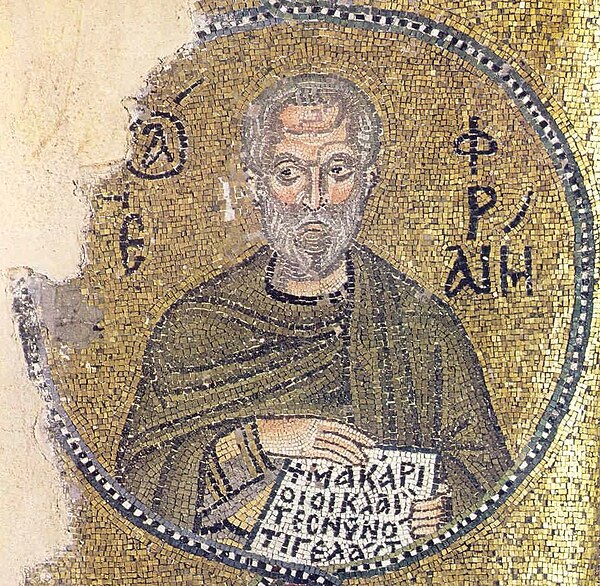
Portrait of Ephrem the Syrian
via Wikipedia

Ephrem the Syrian

c. 306 – 373 · b. Nisibis
deacontheologian

Syriac deacon, hymnographer and poet-theologian of Nisibis and Edessa. Author of the Hymns on Faith and Hymns on Paradise.

Why Ephrem the Syrian matters

Ephrem wrote in Syriac, not Greek or Latin, and proves that early Christianity had a third intellectual tradition we usually forget. His hymns and theological poetry are still sung in Syriac churches every week, and they pre-date most of the major Greek and Latin Fathers. If you want to feel the texture of a Christianity that grew up outside the Roman Empire — closer to the Aramaic world Jesus actually lived in — read Ephrem. Most people never have, which is why his fingerprint on later Christian theology is invisible to most Christians.

Chain to Jesus

Loading…

Common questions

Who was Ephrem the Syrian?
Ephrem the Syrian (306–373) — Syriac deacon, hymnographer and poet-theologian of Nisibis and Edessa. Author of the Hymns on Faith and Hymns on Paradise.
Who did Ephrem the Syrian meet?
Basil of Caesarea.

Works

  • Hymns on Paradisec. 370

    Theological poetry — the high water mark of Syriac Christianity.

As an Amazon Associate we earn from qualifying purchases.

Sources for biography

  • Ephrem, Hymns on Faith primary
  • Jerome, De Viris Illustribus 115 primary
  • Sozomen, Hist. Eccl. 3.16 primary

documented connections(1)

  • cited (incoming) Jacob of Serugh
    Jacob writes in the metrical-homiletic Syriac tradition pioneered by Ephrem and explicitly invokes him.
    Jacob of Serugh, Memra on Ephrem · Sebastian Brock, A Brief Outline of Syriac Literature · ODCC s.v. James of Sarug

tradition connections(4)

  • Late tradition reports a visit between Ephrem and Basil at Caesarea.
    Sozomen, Hist. Eccl. 3.16
  • knew of Aphrahat
    Ephrem and Aphrahat are the two principal 4th-century Syriac Fathers and share the same theological idiom (typological exegesis, anti-Jewish polemic, ascetic ideals). Direct citation is not preserved; the link is the shared Syriac milieu and parallel content noted by modern scholarship.
    Murray, Symbols of Church and Kingdom (CUP 1975), pp. 29-38 · Brock, The Luminous Eye (Cistercian 1992), ch. 1
  • cited (incoming) Romanos the Melodist
    Romanos, a Syrian-born deacon writing in Greek at Constantinople under Anastasius and Justinian, draws heavily on Ephrem's Syriac madrashe and memre in form and theology. Direct quotation is not preserved; the dependence is the modern scholarly consensus.
    Petersen, The Diatessaron and Ephrem Syrus as Sources of Romanos the Melodist (CSCO 475, 1985) · Brock, From Ephrem to Romanos (Variorum 1999)
  • knew of (incoming) Aphrahat
    Aphrahat (writing 337-345 in Sasanian Persia) and Ephrem (in Roman Nisibis/Edessa) are the two great early Syriac authors and near-contemporaries. Direct contact is not attested in primary sources; the linkage is a scholarly/traditional pairing of the founders of Syriac theological literature.
    Sebastian Brock, A Brief Outline of Syriac Literature · ODCC s.v. Aphraates

Read more