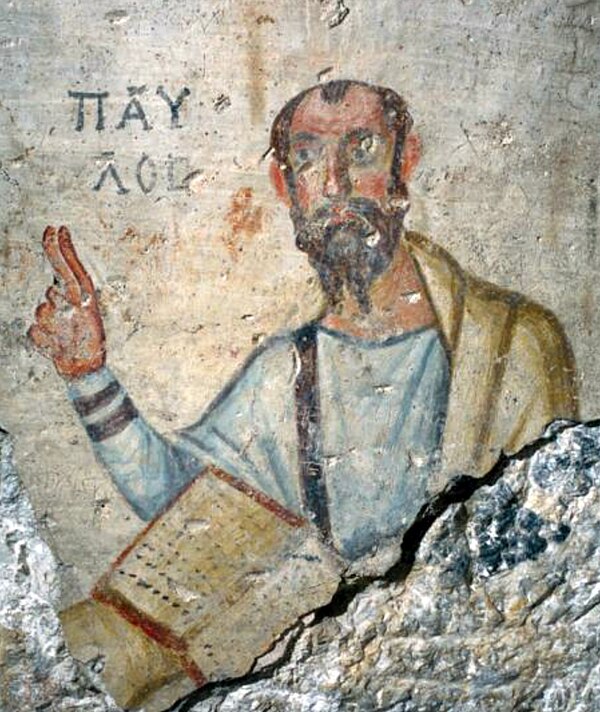
Paul of Tarsus
Quick facts
- Born
- c. 5, Tarsus
- Died
- c. 65, Rome
- Region
- asia minor
- Era
- apostle
- Significance
- Apostolic / Christ(4/4)
- Also known as
- Saul of Tarsus · the Apostle Paul
Highlights
- Main contribution
- Paul forced the first Christian generation to decide whether the gospel was for Israel only or for the nations.
- Event connection
- Council of Jerusalem (50)
- Primary source
- Acts of the Apostles 9, 13-28
Pharisee turned apostle to the Gentiles after his Damascus-road encounter. Author of at least seven undisputed letters in the New Testament; martyred in Rome under Nero.
Why Paul matters
Paul forced the first Christian generation to decide whether the gospel was for Israel only or for the nations. His mission to Gentiles, his argument against requiring the Mosaic Law for conversion, and his letters about grace, faith, resurrection, church order, and life in Christ shaped the categories every later theologian used. He did not invent Christianity, but he made clear what the death and resurrection of Jesus meant once the message crossed ethnic and legal boundaries. The patristic age keeps returning to Paul because its deepest disputes already have Pauline terms.
Chain to Jesus
Loading…
Common questions
- Who was Paul of Tarsus?
- Paul of Tarsus (5–65) — Pharisee turned apostle to the Gentiles after his Damascus-road encounter. Author of at least seven undisputed letters in the New Testament; martyred in Rome under Nero.
- Who did Paul of Tarsus teach?
- Timothy, Titus, Luke the Evangelist, and Onesimus.
- Who did Paul of Tarsus meet?
- Peter, James the Just, and Mark the Evangelist.
- Who did Paul of Tarsus oppose?
- Peter and James the Just.
Sources for biography
- Acts of the Apostles 9, 13-28 primary
- Galatians 1-2 primary
- 1 Clement 5 primary
- Eusebius, Hist. Eccl. 2.22, 2.25 primary
documented connections(11)
- knew of Jesus of NazarethPaul claims a resurrection appearance and direct revelation (Galatians 1:11-17, 1 Cor 15:8). Not a pre-Easter disciple.1 Corinthians 15:8 · Galatians 1:11-17 · Acts 9:1-19
- met PeterPaul visited Cephas in Jerusalem for fifteen days c. AD 36 (Gal 1:18). They later met at the Apostolic Council (Gal 2 / Acts 15).Galatians 1:18; 2:1-10 · Acts of the Apostles 15
- opposed PeterThe Antioch incident: Paul publicly rebuked Peter for withdrawing from Gentile table fellowship under pressure from 'men from James' (Gal 2:11-14).Galatians 2:11-14
- met James the JustPaul met James in Jerusalem (Gal 1:19) and again at the Apostolic Council (Gal 2:9 / Acts 15).Galatians 1:19; 2:9 · Acts 15:13; 21:18
- taught TimothyActs 16:1-3 · 1 Timothy 1:2 · Philippians 2:19-22
- taught TitusGalatians 2:1-3 · Titus 1:4-5 · 2 Corinthians 7:6-15
- taught Luke the EvangelistLuke is named as Paul's companion in Colossians 4:14, Philemon 24, 2 Timothy 4:11; Irenaeus calls him 'a follower of Paul'.Colossians 4:14 · 2 Timothy 4:11 · Irenaeus, Adv. Haer. 3.1.1
- Mark accompanied Paul and Barnabas, then split (Acts 13:13; 15:37-39). Later reconciled (Col 4:10; 2 Tim 4:11).Acts 13:13; 15:37-39 · Colossians 4:10
- taught OnesimusPhilemon 10-16
- cited (incoming) Polycarp of SmyrnaPolycarp's Letter to the Philippians quotes or alludes to most of the Pauline corpus extensively.Polycarp, To the Philippians (passim, esp. 3.2, 11.2-3)
- cited (incoming) Ignatius of AntiochIgnatius alludes repeatedly to Pauline letters (esp. 1 Cor, Eph) and explicitly praises Paul (Eph. 12.2; Rom. 4.3).Ignatius, To the Ephesians 12.2 · Ignatius, To the Romans 4.3
tradition connections(2)
- opposed James the JustPaul was opposed not by James personally but by 'certain men from James' whose intervention triggered the Antioch incident (Gal 2:12). The direct opposition between Paul and James himself is inferred and disputed by scholars.Galatians 2:12
- knew of (incoming) Clement of Rome1 Clement 5 speaks vividly of Paul's martyrdom in the first person plural ('our generation'); patristic tradition (Origen, Eusebius, Jerome) identifies Clement with the fellow worker of Phil 4:3.1 Clement 5 · Philippians 4:3 · Eusebius, Hist. Eccl. 3.15