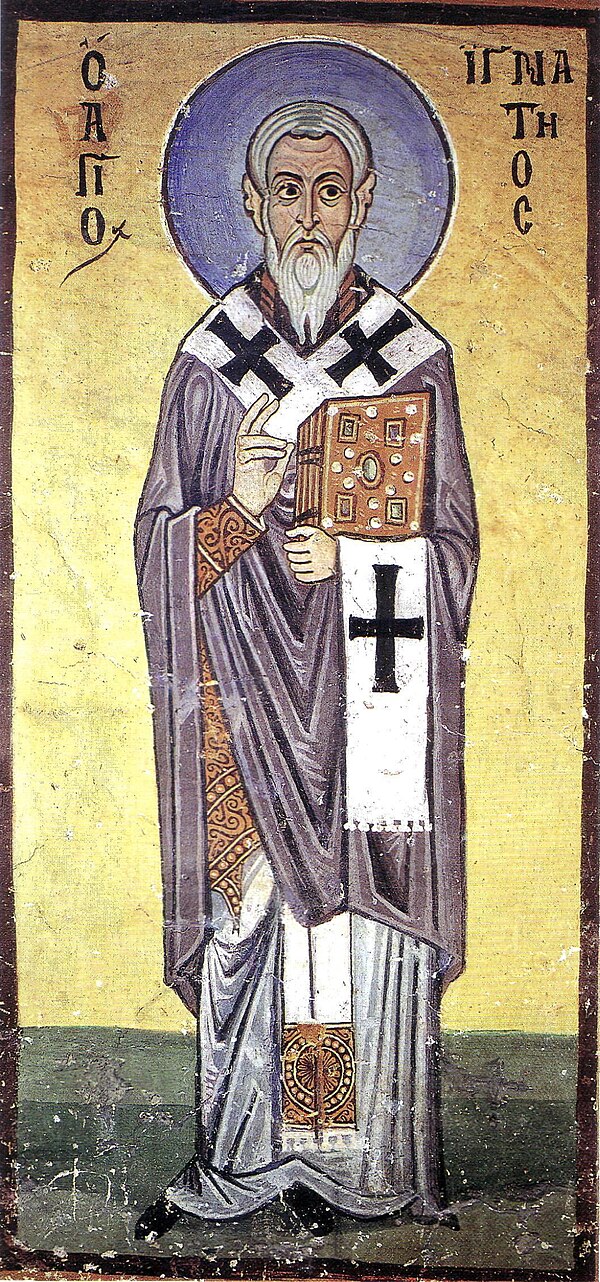
Portrait of Ignatius of Antioch
via Wikipedia

Ignatius of Antioch

c. 35 – c. 108 · Bishop of Antioch
BishopMartyr

Quick facts

Born
c. 35
Died
c. 108, Rome
See
Antioch
Region
syria
Era
apostolic father
Significance
Major Father(3/4)
Also known as
Theophorus

Highlights

Main contribution
Ignatius turned the road to execution into seven letters the church never forgot.
Primary source
Ignatius, Letters (Ephesians, Magnesians, Trallians, Romans, Philadelphians, Smyrnaeans, To Polycarp)

Bishop of Antioch, arrested and sent to Rome under Trajan c. 107-110, writing seven letters en route to the churches and to Polycarp. Martyred in Rome.

Why Ignatius matters

Ignatius turned the road to execution into seven letters the church never forgot. As he was being taken to Rome under Trajan, he wrote to churches about Christ's real flesh, the Eucharist, martyrdom, unity, and the bishop as the visible centre of a local church. He is the first writer to use 'Catholic' as a description of the universal church. If later Christians argue about bishops, sacraments, unity, or martyrdom, Ignatius is already in the room.

Recommended reading near Ignatius

A cover-visible starting point chosen from the curated reading path, either by this figure or by their era.

More books →
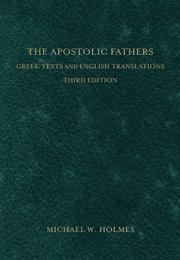
Cover of The Apostolic Fathers, edited and translated by Michael W. Holmes
Start here if you want the generation just after the apostles.

The Apostolic Fathers

Clement of Rome

Best first collection for Clement, Ignatius, Polycarp, the Didache, Barnabas, Hermas, and Papias in one place.
Chain to Jesus

Loading…

Common questions

Who was Ignatius of Antioch?
Ignatius of Antioch (35–108) — Bishop of Antioch, arrested and sent to Rome under Trajan c. 107-110, writing seven letters en route to the churches and to Polycarp. Martyred in Rome.
Who taught Ignatius of Antioch?
John the Apostle.
Who did Ignatius of Antioch correspond with?
Polycarp of Smyrna and Onesimus.
Who did Ignatius of Antioch succeed as bishop of Antioch?
Evodius of Antioch.

Works

  • Letter to the Ephesiansc. 107

    His longest letter; lays out the bishop-as-symbol-of-God-the-Father model that became universal.

  • Letter to the Magnesiansc. 107

    Argues Christians have moved beyond Sabbath observance to the Lord's Day.

  • Letter to the Tralliansc. 107

    Brief; warns against docetism — Christ truly suffered.

  • Letter to the Romansc. 107

    The most personal — begs the Romans not to intervene to save him from martyrdom.

  • Letter to the Philadelphiansc. 107

    Polemic against Judaizers; the bishop is the centre of unity.

  • Letter to the Smyrnaeansc. 107

    Earliest use of the term 'Catholic Church' (8.2) — meaning universal, not denominational.

  • Letter to Polycarpc. 107

    Personal letter to Polycarp of Smyrna with pastoral advice for a young bishop.

As an Amazon Associate we earn from qualifying purchases.

Sources for biography

  • Ignatius, Letters (Ephesians, Magnesians, Trallians, Romans, Philadelphians, Smyrnaeans, To Polycarp) primary
  • Eusebius, Hist. Eccl. 3.22, 3.36 primary
  • Polycarp, Phil. 9, 13 primary

documented connections(3)

  • corresponded Polycarp of Smyrna
    Ignatius wrote a personal letter to Polycarp en route to Rome; Polycarp in turn forwarded the corpus of Ignatian letters to the Philippians (Phil 13).
    Ignatius, To Polycarp · Polycarp, To the Philippians 13
  • corresponded (incoming) Polycarp of Smyrna
    Polycarp, To the Philippians 9, 13 · Ignatius, To Polycarp
  • Ignatius alludes repeatedly to Pauline letters (esp. 1 Cor, Eph) and explicitly praises Paul (Eph. 12.2; Rom. 4.3).
    Ignatius, To the Ephesians 12.2 · Ignatius, To the Romans 4.3

tradition connections(3)

  • Later tradition (e.g. the Martyrium Ignatii and John Chrysostom) makes Ignatius a disciple of John alongside Polycarp; not attested by Ignatius himself or by Irenaeus.
    Martyrium Ignatii (later acta) · Chrysostom, Hom. on Ignatius
  • succeeded in see Evodius of Antioch
    Antiochene episcopal succession is preserved only by Eusebius writing c. 320; no 1st-c Antiochene source survives to confirm.
    Eusebius, Hist. Eccl. 3.22, 3.36
  • corresponded Onesimus
    Ignatius greets a Bishop Onesimus of Ephesus in his Letter to the Ephesians; the identification with Paul's freed slave Onesimus is traditional and not certain.
    Ignatius, To the Ephesians 1.3, 6.2

External resources

·XFacebookRedditEmail