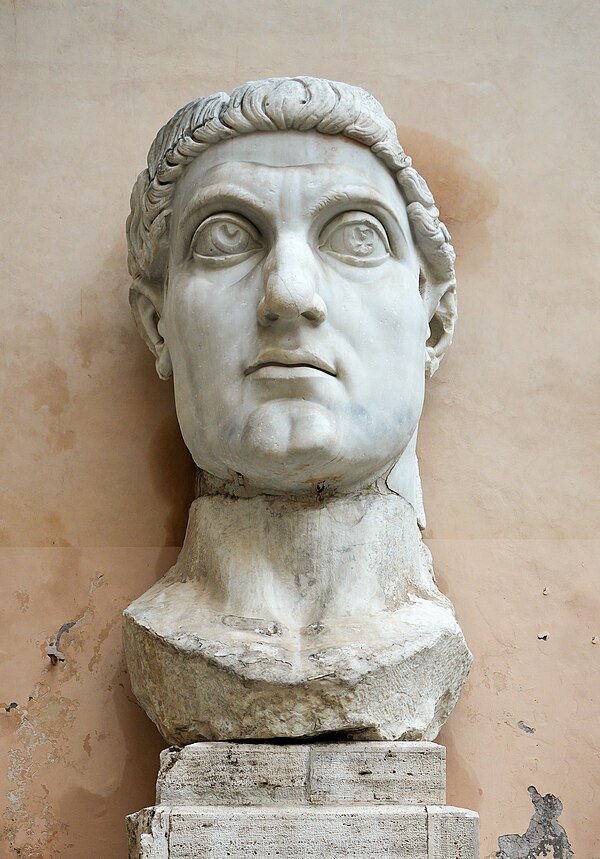
Portrait of Constantine the Great
via Wikipedia

Constantine the Great

c. 272 – 337 · b. Naissus
Emperor

Quick facts

Born
c. 272, Naissus
Died
337, Nicomedia
Region
east
Era
nicene
Significance
Major Father(3/4)
Also known as
Constantine I · Flavius Valerius Constantinus

Highlights

Main contribution
Constantine changed the conditions under which Christianity lived.
Event connection
Edict of Milan (313)
Primary source
Eusebius, Vita Constantini 1-4

First Christian Roman emperor. Issued the Edict of Milan (313), convened the Council of Nicaea (325), and was baptized on his deathbed by Eusebius of Nicomedia.

Why Constantine the Great matters

Constantine changed the conditions under which Christianity lived. Before him, the church could be persecuted; after the Edict of Milan in 313, it could own property, build openly, receive imperial favour, and gather bishops under imperial summons. He convened the Council of Nicaea in 325, founded Constantinople, and tied Christian history to Roman power in a new way. He did not make Christianity the state religion, and his own baptism came only at the end of his life, but every later Christian argument about empire, patronage, and political power runs through him.

Recommended reading near Constantine the Great

A cover-visible starting point chosen from the curated reading path, either by this figure or by their era.

More books →
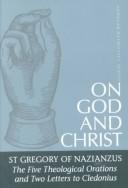
Cover of On God and Christ by Gregory of Nazianzus
Read this when you want the high-theology version of Nicaea.

Five Theological Orations

Gregory of Nazianzus

Dense but decisive sermons on the Trinity from the theologian of Constantinople.
Chain to Jesus

Loading…

Common questions

Who was Constantine the Great?
Constantine the Great (272–337) — First Christian Roman emperor. Issued the Edict of Milan (313), convened the Council of Nicaea (325), and was baptized on his deathbed by Eusebius of Nicomedia.
Who did Constantine the Great correspond with?
Eusebius of Caesarea.
Who baptized Constantine the Great?
Eusebius of Nicomedia.

Sources for biography

  • Eusebius, Vita Constantini 1-4 primary
  • Lactantius, De Mortibus Persecutorum 44-48 primary
  • Socrates Scholasticus, Hist. Eccl. 1.1-1.39 primary

documented connections(4)

  • Eusebius preserves multiple letters from Constantine and delivered an oration in his presence.
    Eusebius, Vita Constantini 2.46, 3.60-63, 4.35-36
  • knew of (incoming) Eusebius of Caesarea
    Eusebius wrote the Vita Constantini and the Tricennial Oration in his honour.
    Eusebius, Vita Constantini 1-4
  • Constantine received baptism from Eusebius of Nicomedia on his deathbed in 337.
    Eusebius, Vita Constantini 4.61-62 · Jerome, Chronicon (s.a. 337)
  • knew of (incoming) Helena
    Helena was the mother of Constantine.
    Eusebius, Vita Constantini 3.42-47

tradition connections(2)

  • knew of (incoming) Lactantius
    Jerome reports that in his old age Lactantius was tutor in Latin to Crispus, son of Constantine, in Gaul. Lactantius dedicated De Mortibus Persecutorum within Constantine's circle.
    Jerome, De Viris Illustribus 80 · Jerome, Chronicon ad ann. 318
  • knew of (incoming) Gregory the Illuminator
    Agathangelos's History of the Armenians records a journey of King Trdat and Gregory to Rome to meet Constantine; the historicity is debated but the tradition links them as contemporary Christian rulers/founders.
    Agathangelos, History of the Armenians 877-895

External resources

·XFacebookRedditEmail