← Lineage
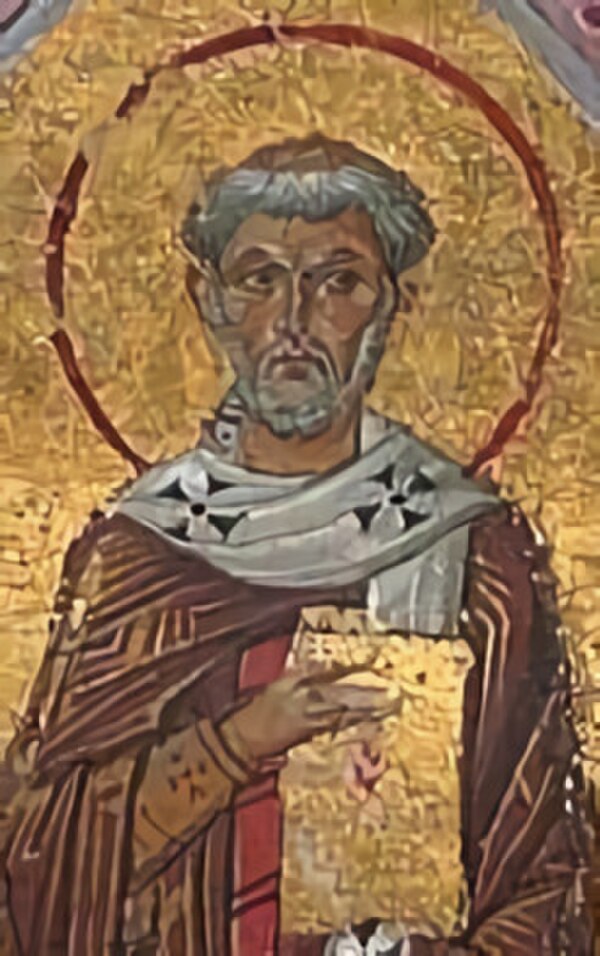
Portrait of Pope Leo I
via Wikipedia

Pope Leo I

c. 400 – 461 · b. Tuscany · Bishop of Rome
bishoptheologian

Bishop of Rome 440-461. His Tome (Epistula 28) was acclaimed at the Council of Chalcedon (451). Negotiated with Attila in 452.

Why Pope Leo I matters

Leo did two things. First, in 451, he sent his Tome to the Council of Chalcedon — a short letter laying out how Christ is one person in two natures — and the council read it and declared 'Peter has spoken through Leo.' That definition is still the test of orthodoxy in every mainstream church East and West. Second, when Attila the Hun came to sack Rome in 452, Leo rode out to meet him and Attila turned around. Whatever actually happened in that conversation, the symbolism stuck. After Leo, the Bishop of Rome is no longer just one bishop among many — he's the figure who speaks for the West and stands in for an empire that's collapsing.

Chain to Jesus

Loading…

Common questions

Who was Pope Leo I?
Pope Leo I (400–461) — Bishop of Rome 440-461. His Tome (Epistula 28) was acclaimed at the Council of Chalcedon (451). Negotiated with Attila in 452.
Who did Pope Leo I correspond with?
Flavian of Constantinople.
Who did Pope Leo I oppose?
Eutyches and Severus of Antioch.
Who did Pope Leo I succeed as bishop of Rome?
Pope Celestine I.

Works

  • Tome (Letter to Flavian)c. 449

    Christological letter that decisively shaped the Council of Chalcedon (451).

  • Sermonsc. 450

    Ninety-six sermons — concise, classical Latin preaching by a master pastor.

As an Amazon Associate we earn from qualifying purchases.

Sources for biography

  • Leo, Tomus ad Flavianum (Ep. 28) primary
  • Leo, Sermones primary
  • Acta Concilii Chalcedonensis (451) primary

documented connections(4)

  • Leo's Tome (Ep. 28) was addressed to Flavian.
    Leo, Epistula 28 (Tomus ad Flavianum)
  • opposed Eutyches
    Leo condemned Eutyches's monophysitism in his Tome.
    Leo, Epistula 28
  • cited (incoming) Pope Agatho
    Agatho's dogmatic letter (Tomus Agathonis) read at the Third Council of Constantinople (681) explicitly invokes and incorporates the Tome of Leo as the standard of Chalcedonian dyothelite Christology.
    Agatho, Epistula ad Constantinum imperatorem, in ACO ser. II vol. 2.1, pp. 52-122 · Acta of the Third Council of Constantinople (681), Session 4
  • opposed (incoming) Severus of Antioch
    Severus rejected the Tome of Leo and the Christological definition of Chalcedon (451), polemicising against Leo's two-natures formula across his letters and treatises (e.g. Contra impium Grammaticum, Philalethes).
    Severus of Antioch, Liber contra impium Grammaticum · Severus of Antioch, Philalethes · ODCC s.v. Severus

tradition connections(1)

  • succeeded in see Pope Celestine I
    Leo became Bishop of Rome (440) following Sixtus III, who succeeded Celestine. Not a direct succession; relationship compresses an intervening pontificate. Source is the Liber Pontificalis, redacted in the 6th c.
    Liber Pontificalis 45-47

Read more